Rest a finished brisket for at least one hour, and two hours is the better target for a whole packer. You can hold it up to about four hours in a preheated cooler, as long as it stays above 140°F. That is how long to rest brisket: long enough for the meat to settle, short enough to stay safely hot.
Or hot, hold it in a 150-degree oven for an overnight sleepover. Best choice in my opinion.
What does resting actually do to a brisket?
Resting lets the internal temperature fall gradually while the meat relaxes and holds its juices. A brisket comes off the smoker at roughly 200°F to 205°F inside, and at that temperature the muscle fibers are loose and the liquid in the meat is hot and thin. Cut it then and much of that liquid runs onto the board.
As the brisket cools slowly, the juices thicken slightly and the fibers firm up enough to hold them. Collagen that has melted into gelatin also sets a little as the temperature drops, which gives the slices a moist, tender bite instead of a dry, crumbly one.
The rest also fixes a practical problem. Brisket is done when a probe slides in with almost no resistance, not at a set time, so it often finishes earlier or later than planned. A long rest gives you a buffer that absorbs those surprises.
If you want the full cook from selection to slicing, the complete brisket cook guide covers every stage that comes before the rest.
How long should you rest a brisket?
Plan on one to two hours for a full packer brisket, and up to four hours if your holding setup is good. The size of the cut and how well you insulate it decide where in that range you land.
- Minimum rest: 1 hour. Anything shorter and you will see a lot of juice on the board.
- Target rest: 1.5 to 2 hours. The meat is still hot, the juices have settled, and the slices hold together.
- Extended hold: 3 to 4 hours. This works well when guests are late, but the meat must stay above 140°F the whole time.
- Small cuts: A trimmed flat or a smaller piece loses heat faster, so 30 to 60 minutes is usually enough.
The 140°F line matters for food safety. Food held below it for long stretches enters the range where bacteria multiply quickly. Check the temperature with a probe during a long hold instead of guessing.
Resting longer is rarely the problem. The common mistake is cutting into the brisket after 15 or 20 minutes because the smell is too good to ignore.
How do you rest a brisket and keep it hot?
Put the wrapped brisket in an insulated box that has been preheated, and keep the lid closed. A cooler works better than the counter because it traps heat and blocks drafts. You can use a hard-sided cooler, a dedicated warming box, or an oven on its lowest warm setting.
Here is a reliable method using a cooler:
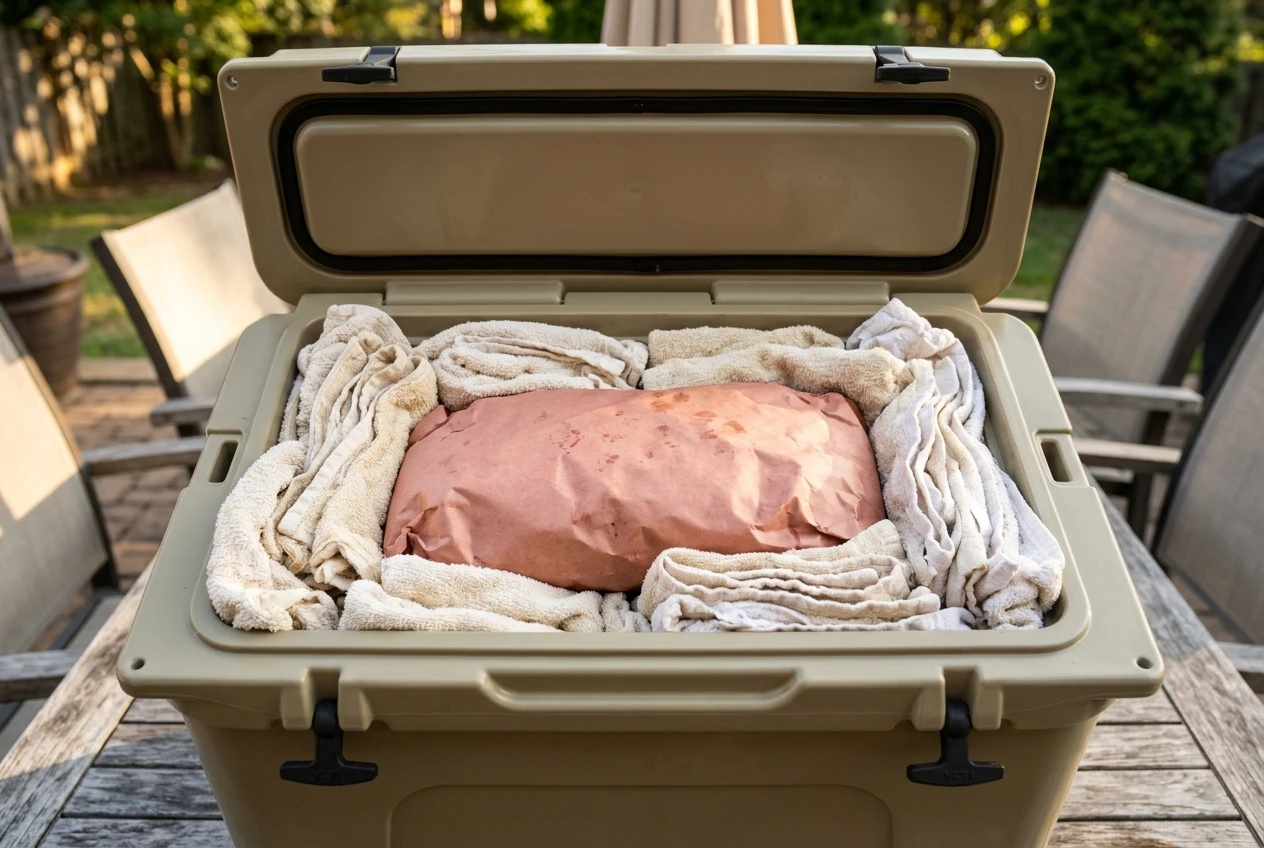
- Preheat the cooler. Fill it with hot tap water, close the lid, and let it sit for 15 to 20 minutes. Pour the water out and dry the inside.
- Line it with towels. Lay a thick, dry towel on the bottom so the brisket does not sit directly on cold plastic.
- Wrap the brisket. Keep it in its butcher paper or foil, or wrap it now if you pulled it unwrapped (see the next section).
- Place it in the cooler. Set the brisket on the towel, fat side up if you can, and pack more towels around and over it to fill the gaps. Empty space loses heat.
- Close the lid and leave it. Every time you open it, heat escapes.
- Probe before slicing. Check that the thickest part is still above 140°F.
An oven works too. Set it to the lowest warm setting your oven has, put the wrapped brisket on a tray, and check the internal temperature occasionally. The advantage is steady heat. The drawback is that some ovens run hotter than you want, which can keep cooking the meat, so confirm the setting with an oven thermometer.
A reliable instant-read probe is what makes any of this safe, and it is one of the items on the backyard pitmaster gear list.
Should you rest brisket wrapped or unwrapped?
Rest it wrapped. A wrapped brisket loses heat more slowly and keeps its surface from drying out, which is what you want over a one to four hour hold. Resting it bare on a board works only for a short rest, and the outside cools quickly.

The wrap material changes the result:
Method | Heat retention | Bark | Best for |
|---|---|---|---|
Butcher paper | Good | Stays firmer, slightly softens | Long rests where you want to protect the bark |
Foil | Very good | Softens more because steam is trapped | Longest holds where heat matters most |
Unwrapped | Poor | Stays crisp | Short rests of 20 to 30 minutes only |
Paper, then towels in a cooler | Excellent | Mostly kept | Most backyard cook days |
If you cooked the brisket wrapped in foil, leave it in the foil for the rest. If you cooked it unwrapped, wrap it in butcher paper or foil as soon as it comes off, because the surface starts losing heat the moment it leaves the smoker.
One trade-off to know: trapped steam softens bark. If a crunchy crust matters to you, use paper rather than foil, and avoid opening the wrap during the hold.
What happens if you slice brisket too soon?
Slice too soon and the juices pour onto the cutting board instead of staying in the meat. The slices come out drier, the texture is less cohesive, and the steam that escapes carries flavor and moisture with it.
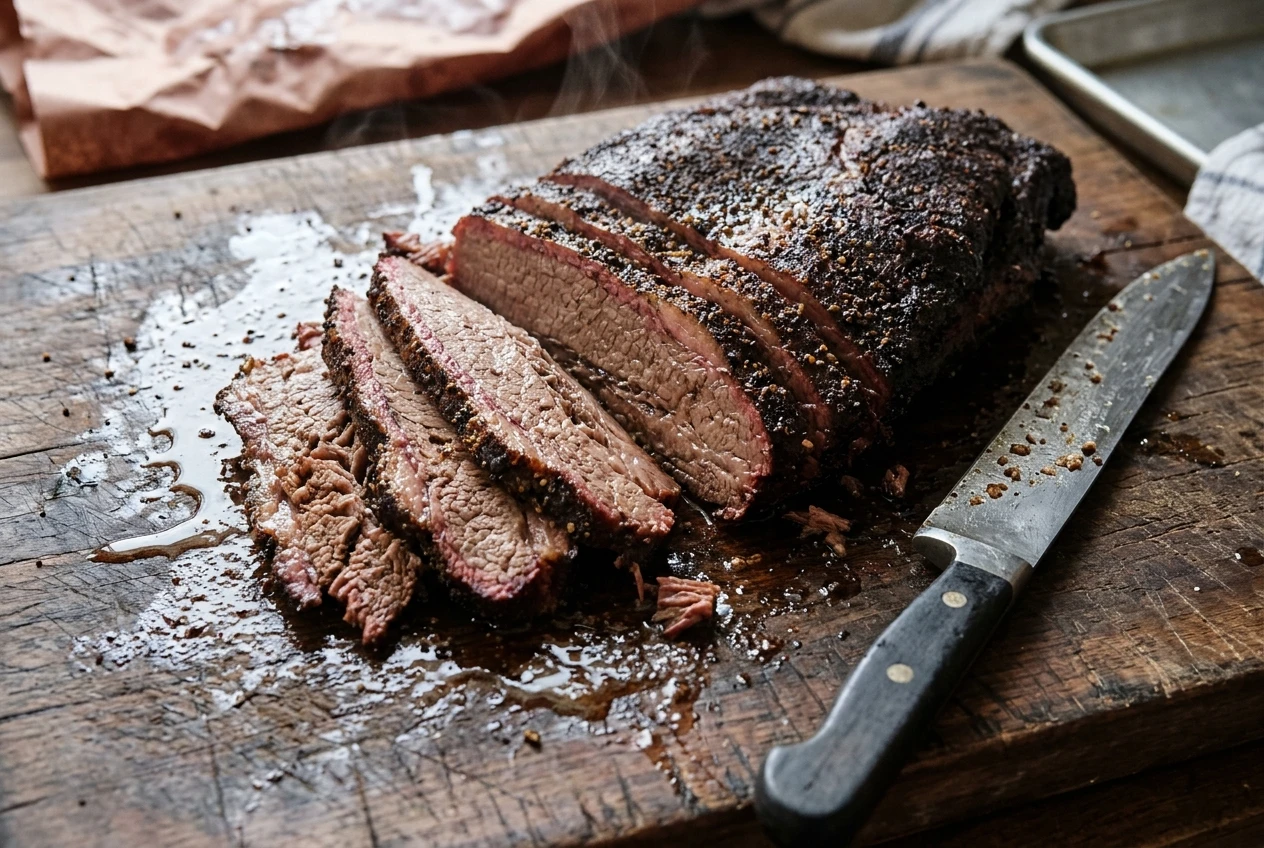
You can usually see the problem right away:
- A pool of liquid spreading across the board.
- Slices that crumble or tear instead of holding their shape.
- Meat that tastes fine but feels dry in the mouth, even though the cook itself was correct.
Slicing late has a different risk. If the brisket falls below 140°F, you have to either serve it lukewarm or reheat it. This is why the holding method matters as much as the clock. A brisket held at a good temperature in a preheated cooler is far more forgiving than one left on the counter for the same time.
If you realize mid-slice that you started too early, wrap the rest back up, return it to the cooler, and give it another 20 to 30 minutes. Slicing only what you need keeps the remainder hot and moist.
How do you build the rest into your cook-day schedule?
Work backward from the time you want to eat. Decide when the first slice should hit the plate, subtract the rest, and that gives you the time the brisket must come off the smoker. Then add a buffer, because the cook itself is the least predictable part of the day.
Here is an example schedule for serving at 6:00 PM:
- 5:45 PM: Unwrap, slice, and plate.
- 3:45 PM: Brisket comes off the smoker and goes into the cooler for a two-hour rest. This is your target finish time.
- Earlier than 3:45 PM: Aim for the brisket to be done by roughly 2:45 PM, giving yourself an hour of slack if it finishes early or stalls late.
- Cook start: Work back from 2:45 PM using the size of your brisket and your smoker’s pace. Many cooks start in the middle of the night or very early morning for that reason.
The extra hour is not wasted. If the brisket finishes early, it simply rests longer in the cooler, which is harmless as long as it stays above 140°F. If it finishes late, you shorten the rest rather than serving dinner at midnight.
A few habits make the schedule hold up:
- Preheat the cooler while the brisket is in its last stretch, so it is ready when you pull the meat.
- Do not set the dinner time first and the cook time second. Decide the target finish, then tell guests to arrive close to it.
- Prepare the sides during the rest. The brisket does not need you for those 90 minutes, and that is the best time to finish everything else.
Treat the cook-day plan as a range, not a single minute. Brisket finishes when the meat is tender, and a rest long enough to absorb the variation is what lets you serve on time anyway.
How should you slice and serve brisket after the rest?
Slice against the grain, using a long, sharp knife, with slices about the thickness of a pencil. Brisket has two muscles, the flat and the point, and their grain runs in different directions, so you will need to rotate the meat when you switch between them. This is a great time to make burnt ends out of the point
Follow this order:

- Unwrap over a tray. Pour any juices from the wrap into a cup. This liquid is worth keeping.
- Separate the point from the flat if you want to slice each one on its own. A natural seam of fat divides them.
- Slice the flat across the grain in even slices, using long, smooth strokes instead of sawing. ( This is important )
- Turn the point and slice across its grain, or cut it into cubes if you want burnt-end style pieces.
- Spoon a little of the saved juice over the sliced meat to keep it moist on the plate.
Slice only what will be eaten in the next several minutes and keep the rest whole and wrapped. A whole piece holds its moisture and heat far better than cut slices, which cool and dry out quickly.
Brisket rewards patience at the end more than almost any other step. If you have a question about your own rest, hold time, or cook-day timeline, please let me know in the comments below.
Thanks for reading
Rolland @ Dalliciousbbq